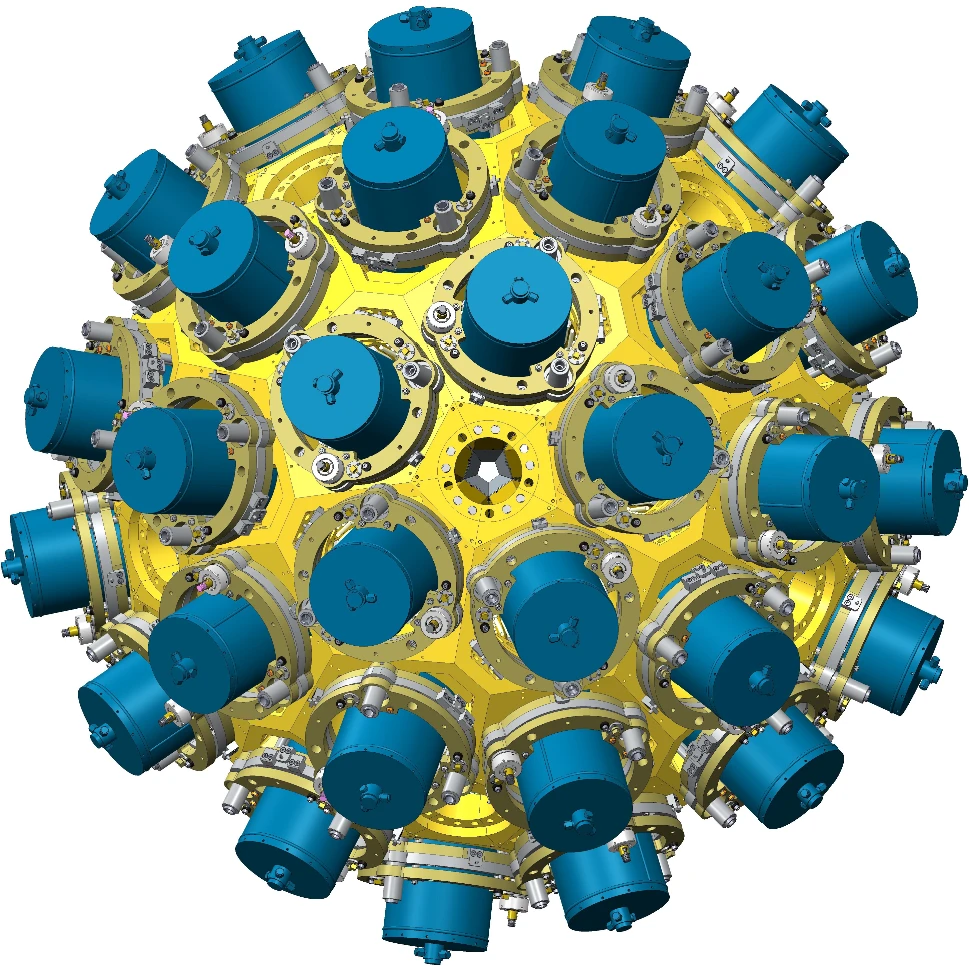
AGATA (Advanced Gamma Tracking Array) is a European research project with the aim of developing and building a next-generation 4π gamma-ray spectrometer. It will be used in experiments using both intense stable and radioactive ion beams, to study the structure of atomic nuclei as a function of angular momentum, isospin, and temperature at the limits of their stability.
AGATA is based on the principle of gamma-ray tracking, made possible by segmented high-purity germanium crystals, advanced digital electronics, and pulse-shape analysis. Using these technologies, the precise energy and 3D position of each interaction point of the Compton-scattered gamma rays will be determined. Sophisticated gamma-ray tracking algorithms will reconstruct the full energy and first interaction point of the gamma rays that hit the spectrometer. The full AGATA spectrometer will consist of an array of 180 large (9.0 cm length, 8.0 cm circular diameter) encapsulated high-purity germanium (HPGe) crystals. The crystals are tapered (hexaconical) and segmented electrically into 36 segments (6 longitudinal, 6 transversal).
The AGATA collaboration consists of several hundred scientists, engineers, and students from about 40 research institutes in 13 European countries: Bulgaria, Germany, Italy, Finland, France, Hungary, Poland, Romania, Slovenia, Spain, Sweden, Turkey, and the UK. AGATA is an open collaboration and welcomes new members